

 Menu
Menu Submenu for Figueroa Research
Quantum Computing Underground
Quantum Computing Underground
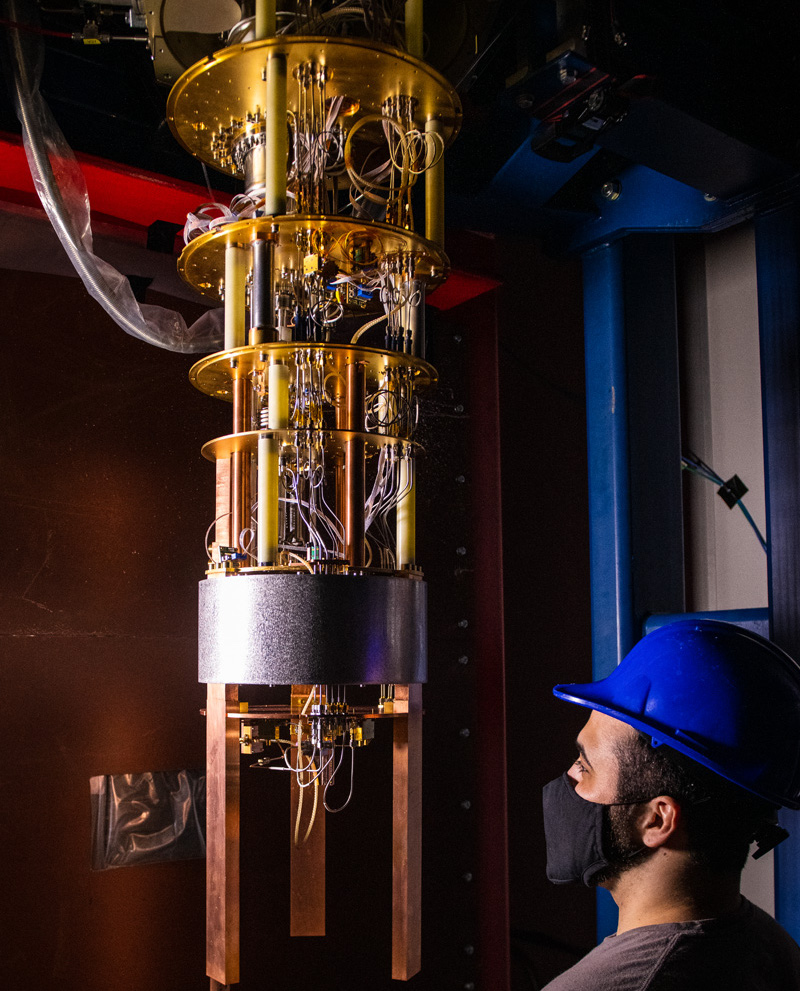
Our technology has been bases on cryogenic superconducting detectors. We are now also working on superconducting qubit-based quantum detection. Can qubits acts as particle sensors? On the other hand, radiation and cosmic rays pose a serious obstacle to large-qubit superconducting quantum computers. Energetic photons and particles can deposit large amounts of energy in a qubit chip, leading to significant decoherence of the system. Our work in understanding and modeling the interaction between superconducting qubits and their environment is a two-way street: we can design qubits to be very sensitive particle detectors, or we can turn the knob the other way and design qubits that are very insensitive to their environment, thus improving their coherence and making better quantum computers.
We are interested in designing new qubits for computation that benefit from our understanding of the micro-physics around each qubit. Qubits that either are insensitive to their environment or are aware and use that information as part of the compilation and computation process can lead to beter fault-tolerant quantum computers.